
Scroll through any paid social feed and you’ll notice the same thing: the ads that stop you rarely look like ads. They look like something a friend filmed in their kitchen, a bedroom, or a parking lot. That’s not an accident—it’s the core logic behind UGC-style advertising.
The numbers make the case plainly. UGC ads see 4x higher click-through rates than traditional ads and cost roughly 50% less per click. Meanwhile, consumers have largely developed what you might call advertising immunity—the instinct to ignore anything that feels polished, corporate, or scripted. UGC-style content slips past that defense because it triggers the same trust response as a personal recommendation.
But here’s the nuance most guides miss: authenticity isn’t the same as randomness. High-converting UGC ads follow deliberate frameworks. This guide walks through exactly how to build them—from scripting and shooting to testing and scaling.
What Makes a UGC-Style Ad Different
A UGC ad is a paid advertisement built to look and feel like organic content created by a real person—not a brand’s studio team. The format works because it mimics how people naturally talk about products they love. It can be genuinely creator-made or produced to replicate that aesthetic intentionally.
The key differences from traditional video production:
- Environment: Real spaces (homes, cars, gyms) rather than sets or studios
- Camera: Handheld smartphone framing, minor shake, natural light
- Delivery: Conversational speech, imperfect pacing, contractions and filler words
- Editing: Jump cuts, on-screen captions, trending audio—native to the platform
- Length: Typically 15–60 seconds, structured around a single clear point
What separates a converting UGC ad from one that wastes budget isn’t production quality in the traditional sense—it’s strategic structure wrapped inside an authentic presentation.
The Script Framework Every UGC Ad Needs
The most reliable structure for UGC ad scripts follows a direct-response sequence: Hook → Problem → Solution → Social Proof → CTA. Here’s how each beat functions in practice.
The Hook (0–3 Seconds)
The hook is the single highest-leverage variable in any UGC ad. If you lose someone in the first three seconds, nothing else matters. Effective hooks create impact through relatability, a bold claim, a surprising visual, or a direct-address question. Examples of formats that work:
- “I can’t believe I wasted two years doing it the old way…”
- “This is the only [product category] that actually works for me.”
- A striking before-and-after visual with no voiceover in frame one
- A direct question: “Why is no one talking about this?”
When testing, isolate the hook variable—keep the rest of the script constant—so you can read clean performance data and identify what’s actually moving the needle.
Problem & Solution (3–25 Seconds)
Name the specific frustration your audience knows intimately, then transition into how the product solves it. Be concrete. Vague problems produce vague results. This section should feel like a friend describing their genuine experience, not a marketing pitch. Use contractions, natural pauses, and phrases like “honestly” or “I wasn’t expecting this.” Write how people talk.
Social Proof & CTA (Final 10–15 Seconds)
Close with validation—a result, a number, a brief testimonial line—then a single clear call to action. One CTA. Choosing multiple actions to ask the viewer to take splits their attention and hurts conversions. Keep it direct: “Link in bio,” “Tap to shop,” or “Try it free for 30 days.”
Shooting for the UGC Aesthetic (Without Looking Cheap)
The goal isn’t bad production—it’s intentional production that feels native. There’s a meaningful difference. Here are the practical decisions that get you there.
Camera & Framing
- Shoot vertical (9:16) for TikTok, Reels, and Stories by default. For more on framing vertical content well, see the Tone Production blog for additional production guides.
- Use a smartphone or a mirrorless camera with a slightly imperfect framing—dead-center, slightly low-angle, or held at arm’s length all work
- Slight natural camera movement is fine; excessive shake is not—a light grip beats a locked tripod for this look
- Keep the subject close to the lens; talking-head UGC almost always frames from mid-chest up
Lighting
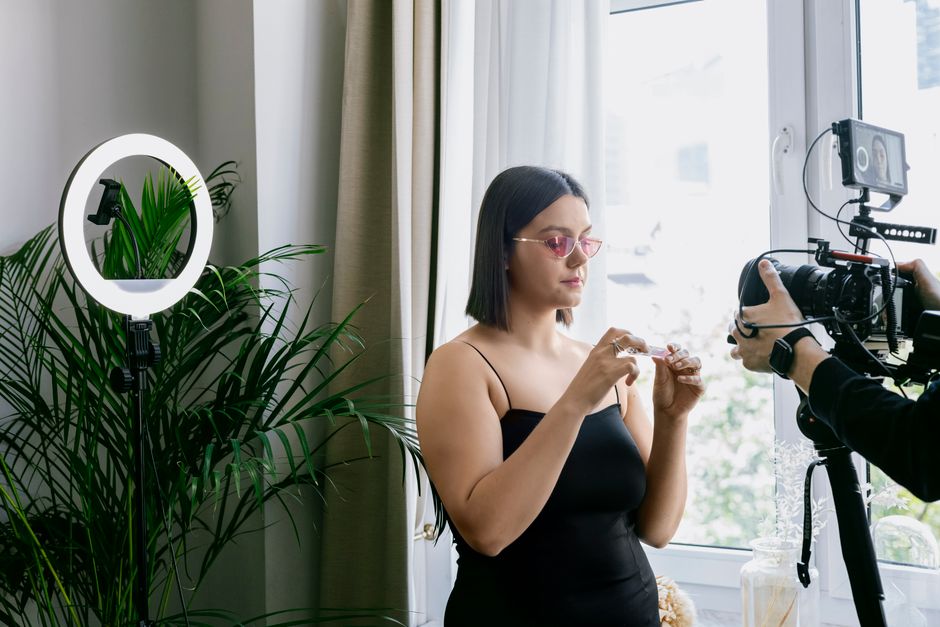
Window light is your best friend. Position the subject facing a large window for soft, flattering natural illumination that reads as “filmed at home.” A small ring light can stand in, but avoid the telltale circular catchlight that signals professional production to savvy viewers. Overcast light outdoors also works exceptionally well.
Audio
This is where many UGC-style ads stumble. Room echo, HVAC noise, and muddy dialogue kill credibility faster than imperfect framing does. A clip-on lavalier mic—even a basic wired lav attached to a phone—makes an enormous difference. Clear audio reads as trustworthy even when the visual is deliberately casual.
Environment & Props
Show the product in real use within a recognizable context. A supplement filmed on a kitchen counter outperforms the same product on a white sweep. A software product demoed on a real desk with scattered papers converts better than a sterile screen recording. The environment is part of the social proof.
UGC Format Types and When to Use Each
Different formats serve different funnel stages and product categories. Choose based on what your product actually needs to demonstrate:
- Testimonial/talking-head: Best for trust-building at the top of funnel; works across almost every category
- Unboxing: High anticipation value; effective for physical products where first-impression experience matters
- Tutorial/how-to: Demonstrates value through education; strong for software, tools, and complex products
- Before-and-after: Visual proof of transformation; dominant format in skincare, fitness, home improvement
- Day-in-the-life: Integrates the product into a relatable routine; effective for lifestyle and habit-based products
- Reaction/discovery: “I just found this and I’m obsessed” framing; drives curiosity and click-through
Platform-Specific Optimization
A UGC ad built for one platform will underperform on another if you don’t adapt it. Each platform has its own visual language.
TikTok
TikTok rewards fast pacing and content that feels genuinely native—think trending sounds, text overlays, and immediate value in frame one. The first frame earns the second. Sound-on viewing is the norm, so audio quality and voiceover matter here more than on other platforms.
Meta (Facebook & Instagram Reels)
Meta feed ads frequently play on mute, so captions must carry the full message independently of the voiceover. Pacing can be slightly slower than TikTok. Instagram Reels sits between TikTok and Facebook in terms of acceptable production polish—slightly more visual quality is expected without killing authenticity.
YouTube Shorts
Viewers skipping pre-roll ads have a low patience threshold. Your hook must hit inside the first two seconds, and the value proposition needs to be crystal clear before the viewer has a chance to mentally opt out.
Creator Briefs That Actually Produce Good Content
Whether you’re working with a paid UGC creator or an internal team member, a strong brief is the difference between footage that converts and footage that sits unused. A brief should include:
- Brand voice guidelines: Tone, personality, and language to use (and avoid)
- Target audience details: Who they are and what they care about
- Key messages: The two or three points that must land
- Shot list: Required footage—talking head, product close-up, B-roll in context
- Hook options: Give creators two or three hook variations to test
- Usage rights: Clarify upfront which platforms, timeframes, and edits are permitted
Micro-creators—those with 5,000 to 50,000 followers—often deliver stronger authenticity and higher engagement per viewer than larger influencers. Their niche audiences are more invested, which translates directly into better conversion rates when their content is repurposed as paid ads.
Testing and Scaling What Works
The brands winning with UGC treat it as a system, not a one-off campaign. The process: produce multiple hook variations, run controlled tests with a single variable changed at a time, measure performance for at least three to five days before drawing conclusions, then scale spend behind proven winners.
Key metrics to track beyond raw click-through rate:
- Hook rate: Percentage of viewers who watch past the three-second mark
- Hold rate: Percentage who watch to 50% or 75% of total length
- Cost per purchase or cost per lead: The bottom-line conversion metric
- Frequency vs. engagement drop-off: UGC ads experience creative fatigue like any other format—monitor and rotate creative regularly
For brands running paid social at scale, working with a video production team that understands both the creative and the performance data side is a significant advantage. Teams like Tone Production in Houston and Atlanta are experienced in producing performance creative—including UGC-style content—built around real conversion objectives, not just aesthetic choices.
Common Mistakes That Kill Conversions
- Over-scripting: Creators reading word-for-word from a teleprompter destroys the spontaneous feel that makes UGC work
- No single clear CTA: Asking viewers to do too many things results in them doing nothing
- Burying the hook: Starting with brand logos, intros, or product shots before establishing why the viewer should care
- Ignoring captions: A significant portion of social video is watched on mute—always add captions
- Testing complete ads instead of variables: You learn faster by isolating one element at a time
- Treating UGC as a one-time effort: Creative fatigue is real; a winning ad needs refreshed hooks or new angles every few weeks
If you’re producing UGC-style ads for a brand that requires a more polished output alongside authentic feel—think regional retail, healthcare, or B2B—a professional team can bridge both worlds. Tone Production’s New Orleans and Tampa teams regularly produce content that walks this line: strategic, structured, and built to perform in paid social environments without losing the native feel that makes the format work.
Putting It All Together
UGC-style advertising works because it bypasses the skepticism audiences have built up toward traditional ads. But it only converts consistently when it’s built on a real system: a proven script structure, intentional (not accidental) production choices, platform-specific formatting, and a disciplined testing process.
Start with one format, one platform, and two or three hook variations. Measure what holds attention and what drives action. Then build from there. The brands that treat UGC as a creative system—rather than a trend to replicate—are the ones seeing durable results.
If you’d rather hand the production side to professionals, Benjamin Tone and the team at Tone Production produce performance-focused video content—including UGC-style creative—for brands across multiple markets. From scripting and shooting through post-production and delivery, every engagement is led by Benjamin personally. Reach out when you’re ready to build a creative system that actually converts.
Frequently Asked Questions
What is a UGC-style ad?
A UGC-style ad is a paid advertisement designed to look and feel like organic content created by a real person—typically filmed casually on a smartphone, in a real environment, with conversational delivery. It can be made by actual customers, commissioned creators, or produced internally to replicate that aesthetic.
Why do UGC ads convert better than traditional video ads?
UGC ads bypass the ad skepticism audiences have developed toward polished brand content. Because the format mirrors a personal recommendation from a peer, viewers process it differently—evaluating it as social proof before engaging their “this is an ad” filter. Data consistently shows 4x higher click-through rates and roughly 50% lower cost per click compared to traditional creative.
How long should a UGC-style ad be?
For most platforms, 30–60 seconds is the sweet spot. The structure should be: hook in the first 3 seconds, problem and solution through roughly the 25-second mark, then social proof and a single CTA closing out the ad. Short-form placements (TikTok, Reels, Shorts) can compress this to 15–30 seconds if the value proposition is simple.
Do I need to hire real creators to make UGC-style ads?
No. Brands produce effective UGC-style content with internal team members, paid micro-creators, or AI-assisted production tools. The key isn’t who is on camera—it’s whether the script, framing, delivery, and editing feel native to the platform. That said, working with real creators who genuinely use the product tends to produce stronger authenticity cues that audiences pick up on.
What’s the most important element to test in a UGC ad?
The hook. Because the first 3 seconds determine whether someone keeps watching, the hook has more leverage on overall performance than any other element. The best practice is to test multiple hook variations against the same script body so you isolate the variable and get clean data.
How often should I refresh UGC ad creative?
Monitor frequency and engagement drop-off metrics weekly. Most UGC ads show creative fatigue within two to four weeks at meaningful spend levels. Plan to rotate at least the hook—if not the full creative—on a regular cycle. Batching production (filming multiple hooks and angles in one session) makes this much more efficient.
Should UGC ads always have captions?
Yes, always. A large share of social video is watched on mute, especially on Facebook and Instagram. If your captions aren’t present, you’re losing a significant portion of potential conversions. On TikTok, where sound-on viewing is more common, captions still reinforce comprehension and accessibility.
What’s the difference between a UGC creator and an influencer?
An influencer sells both the content and access to their audience—you pay for their reach. A UGC creator produces content in an authentic style that you then use in your own paid ads—you pay for the creative asset, not distribution. Micro-creators (5,000–50,000 followers) can serve both roles, but for paid ad creative specifically, UGC creators offer better cost-efficiency.