
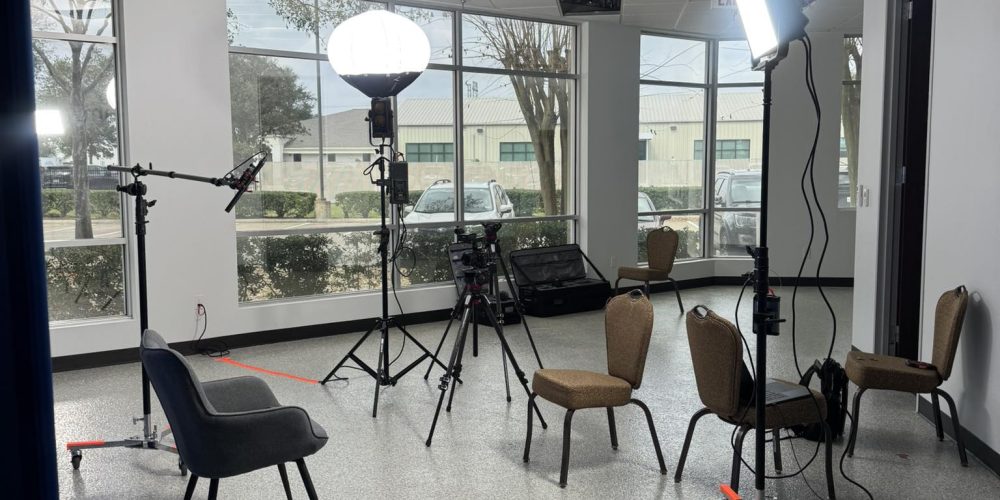
You can nail the lighting, prep smart interview questions, and position your subject perfectly — and still end up with footage that feels flat or unflattering. More often than not, the culprit is lens choice. The best lenses for video interviews do more than capture a sharp image; they shape emotional tone, flatter the subject’s face, and control how much of the environment the viewer sees. Get the focal length wrong and you introduce distortion, lose separation from the background, or simply run out of physical room to work in.
This guide covers everything working videographers need to choose confidently: focal length categories, aperture considerations, prime versus zoom trade-offs, specific lens recommendations by scenario, and the key variables that should drive your final pick on every job.
Why Lens Choice Matters More Than You Think
Every lens decision carries visual weight. Camera lenses influence perception, depth, and intimacy, directly affecting how the audience relates to your subject. A wide-angle lens pushes the camera closer to the subject, which can feel conspiratorial or uncomfortable; a longer telephoto compresses the scene and creates a sense of quiet isolation. Neither is objectively better — they serve different narrative goals.
Lens choice also affects practical workflow. Focal length determines how far back your camera needs to sit, which matters enormously in tight conference rooms or small studio spaces. Aperture determines how much light you can gather, which becomes critical if the location has uncontrollable ambient light. These are not abstract creative decisions; they shape the shoot plan before the crew even arrives on set.
Understanding the Focal Length Categories
Wide-Angle Lenses (14mm–35mm)
Wide-angle lenses are excellent for establishing shots that give the viewer context of the scene — showing the subject within their office, factory floor, or outdoor environment. On a two-camera interview setup, a wide prime or zoom on the A-camera helps orient the audience before cutting to tighter coverage.
The trade-off: wide-angle lenses are not generally flattering for close-up interview work because they can distort and elongate facial features when the camera is positioned near the subject. Use them intentionally for environmental framing, not as a default talking-head lens. A 16–35mm zoom gives you flexibility for b-roll and establishing shots on the same body.
Standard Lenses (35mm–70mm)
This is the sweet spot for most interview work. Standard lenses produce images that are close to how the human eye sees them, without much distortion or compression — which is precisely why they read as natural and trustworthy on screen. A 50mm full-frame prime is often the first lens a videographer reaches for in a controlled interview room.
The 35mm sits at the wider end of standard and works well when you want to include environmental context without fully committing to a wide-angle look. The 35mm lens offers a wider perspective, allowing you to capture more of the surrounding area while maintaining a flattering look — ideal for mid-shots that add narrative context around the subject.
The “nifty fifty” — a fast 50mm prime — remains one of the most cost-effective interview lenses available. Every major manufacturer offers an f/1.8 or f/1.4 version at an accessible price point, and the perspective closely mirrors natural human vision.
Short Telephoto Lenses (70mm–135mm)
For close-up interviews aiming to capture detailed emotions and micro-expressions, longer lenses like a 135mm deliver flattering compression and help focus attention on the subject’s face. This focal range is the professional standard for the B-camera or close-up camera in a two-camera interview setup.
The 85mm is the classic portrait focal length for a reason: it compresses the background smoothly, renders facial proportions accurately, and creates beautiful background separation even at moderate apertures like f/2. In a controlled, sit-down interview, a 50mm or 85mm prime lens can provide crisp images with a smooth, creamy bokeh. If you only own one dedicated interview prime, an 85mm f/1.8 or f/1.4 is the highest-leverage investment.
The 105mm and 135mm options require more camera-to-subject distance, so confirm you have the room before committing. In a small conference room, an 85mm is usually the longest practical choice.
Prime vs. Zoom: The Practical Trade-Off
Prime lenses use a single focal length and deliver sharper images, wider maximum apertures, and more pronounced background separation. Their fixed nature also enforces intentional framing discipline — you move the camera rather than twisting a zoom ring, which tends to produce more considered compositions.
Zoom lenses offer flexible framing across a range of focal lengths, enabling fast adjustments in dynamic or unpredictable environments. On a lean one- or two-person crew, a single zoom can eliminate the need to swap glass mid-shoot — a meaningful time saving when the client is watching the clock.
A 24–70mm f/2.8 zoom covers most interview scenarios on a full-frame camera: wide enough for environmental shots, long enough for a respectable talking-head frame. A 70–200mm f/2.8 on the B-camera gives you flexible telephoto coverage for close-ups and reaction shots. For mobile or on-location setups where time and flexibility are critical, a 24–70mm gives you the ability to change framing without swapping equipment.
For crop-sensor and Super 35 shooters, the Sigma 18–35mm f/1.8 is a well-regarded option: it delivers a nearly-prime-quality aperture across a versatile range that covers wide-standard focal lengths on smaller sensors.
Aperture: Low-Light Performance and Depth-of-Field Control
Lenses with wide apertures (low f-stop numbers) let in more light, producing cleaner images in dim indoor settings and allowing for lower ISO settings, resulting in sharper, less noisy footage. For documentary and corporate work where you may have limited control over the environment, a maximum aperture of f/2 or faster is a meaningful advantage.
That said, shooting interviews wide open at f/1.2 or f/1.4 introduces a very shallow plane of focus. When shooting at these apertures, the depth of field can be so narrow that the eyes are sharp but not the nose — and if the subject sways, focus is lost entirely. Most experienced operators shoot interviews between f/2 and f/4 to balance background separation with a forgiving focus plane, especially when no focus puller is on set.
Outdoors, neutral density filters are essential — they reduce light entering the lens so you can keep your aperture wide open and retain that shallow depth of field even in bright conditions without overexposing.
Lens Recommendations by Interview Scenario
Controlled Corporate Sit-Down (Studio or Office)
- A-Camera: 35mm or 50mm prime for the wider, environmental frame
- B-Camera: 85mm or 105mm prime for close-up emotional coverage
- Sony FE users: the FE 24mm f/1.4 GM for the wide camera; the Sigma 105mm f/1.4 Art or Zeiss Batis 135mm f/2.8 for the close-up camera
- Canon RF users: RF 35mm f/1.8 IS Macro STM paired with the RF 85mm f/2 Macro IS STM offer solid quality-to-price ratios
Documentary or On-Location Interviews
- A versatile 24–70mm f/2.8 zoom on the A-camera covers framing adjustments without lens swaps mid-interview
- A fast 50mm or 85mm prime on a second body for narrative close-ups
- When shooting solo run-and-gun, a wider lens positions the camera closer to the subject, which improves reference audio capture and builds rapport more naturally
Multi-Person Panel or Group Interviews
- Push the A-camera wide enough to contain all subjects in one frame (24mm–35mm range)
- Add a more extreme telephoto on the B-camera and have the operator follow whoever is currently speaking — keeping the close-up energized without excessive cutting
- A 70–200mm f/2.8 zoom gives the B-camera operator the range to isolate individuals across a wide seating arrangement
Sensor Size and the Crop Factor Reality
Every focal-length recommendation in this article assumes a full-frame sensor. If you’re shooting on a crop-sensor camera (APS-C or Super 35), apply the crop factor — typically 1.5x for Sony/Nikon APS-C or 1.6x for Canon APS-C. A 50mm on a crop sensor behaves like roughly an 85mm on a full-frame body, which compresses your options in tight spaces. On a crop body, a 35mm f/1.8 becomes your “standard” interview lens, and a 50mm starts behaving like a short telephoto.
This also means crop-sensor shooters can achieve more background compression at shorter physical focal lengths — a genuine advantage when working in small rooms where a full-frame 85mm would require too much camera-to-subject distance.
Beyond Glass: The Variables That Complete the Picture
No lens overcomes weak fundamentals. A carefully chosen 85mm f/1.4 in a poorly lit room will still produce grainy, unflattering footage. Lens selection works in concert with deliberate lighting setups, proper subject placement, and a well-planned shoot structure. The interview lens is one creative tool among several.
Autofocus quality also matters. For solo operators without a dedicated focus puller, lenses with fast, quiet, accurate continuous autofocus — such as Sony G Master primes or Canon RF lenses with DPAF — reduce the risk of soft close-ups when a subject shifts forward during an animated answer.
For teams executing high-end corporate video productions or branded documentary content, the lens kit is chosen in pre-production as part of the visual language — not improvised on the day. The same planning discipline applies whether you’re working on a single-camera talking head or a multi-camera executive interview for a national campaign.
Ultimately, the right lens is the one that serves the story you’re telling about your subject. The best lens for interviews doesn’t just capture the subject; it tells their story, highlights emotions, and shapes how viewers connect with the narrative. Match your glass to the environment, the emotional tone, and your crew size — and your interview footage will reflect that intention every time.
If you’re building out a professional interview kit or preparing for your first multi-camera corporate shoot, exploring options from Tampa to Baton Rouge, it helps to see how working production teams actually deploy these lenses on real jobs. The gear decisions described here are made every day on professional sets — and the right combination of glass, crew, and preparation makes a measurable difference in the finished product.
Frequently Asked Questions
What is the best focal length for video interviews?
The 50mm and 85mm focal lengths (on a full-frame sensor) are the most widely used for interview video. The 50mm mirrors natural human vision and works in most room sizes. The 85mm creates flattering facial compression and beautiful background separation, making it ideal for close-up emotional coverage on a B-camera. For wider environmental shots, a 35mm or 24mm is used as a complementary angle.
Should I use a prime or zoom lens for interviews?
Both have genuine merit. Prime lenses deliver wider maximum apertures, sharper images at comparable price points, and more pronounced background bokeh — making them the preferred choice for controlled, planned shoots. Zoom lenses (such as a 24–70mm f/2.8) offer faster framing adjustments without swapping glass, which is invaluable on lean crews or run-and-gun documentary work. Many professional interview setups use a prime on the B-camera and a zoom on the A-camera for the best of both approaches.
What aperture should I use for video interviews?
Most experienced operators shoot interviews between f/2 and f/4. Shooting wide open at f/1.2 or f/1.4 creates such a shallow depth of field that focus can be lost if the subject moves even slightly. A moderate aperture like f/2.8 gives you attractive background separation while keeping the entire face sharp — especially important when no dedicated focus puller is on set.
Do wide-angle lenses work for interview video?
Wide-angle lenses (35mm and below on full-frame) are excellent for establishing shots that show the subject in their environment, but they are generally not flattering for close-up interview work. When a wide lens is placed near a subject’s face, it distorts and elongates facial features. Wide glass is best used for B-roll, environmental context shots, or the A-camera frame when you need to show the surrounding space as part of the story.
How does sensor size affect interview lens choice?
Sensor size applies a crop factor that changes the effective focal length. On a typical APS-C crop sensor (1.5x or 1.6x crop factor), a 50mm lens behaves like approximately an 80–85mm full-frame equivalent. This means crop-sensor shooters should reach for a 35mm where a full-frame shooter would use a 50mm, and need to account for reduced working distance when using longer lenses in small rooms.
Is an 85mm lens good for video interviews?
Yes — the 85mm is considered the gold-standard close-up interview lens on full-frame cameras. It compresses the background smoothly, renders facial proportions accurately, and produces flattering results even at moderate apertures like f/2. The main limitation is that it requires sufficient camera-to-subject distance (roughly 8–12 feet for a head-and-shoulders frame), which can be a constraint in small conference rooms.
What lens should I use for a two-camera interview setup?
The classic two-camera interview configuration pairs a medium wide lens (35mm or 50mm) on the A-camera to establish environment and context, with a short telephoto (85mm or 105mm) on the B-camera for emotional close-ups. This gives the editor clean options for cutting between angles without any jump-cut issues, and is the standard approach for corporate videos, documentary interviews, and branded content productions.
Scottsdale Videographers: 6 Reliable Crews for Cinematic Brand Video
New Orleans Videographers: 6 Go-To Crews for Brand Video in 2026
How to Shoot Smooth Handheld Footage: A Cinematographer’s Practical Guide