Why Festival Season Is the Ultimate Test for New Orleans Videographers
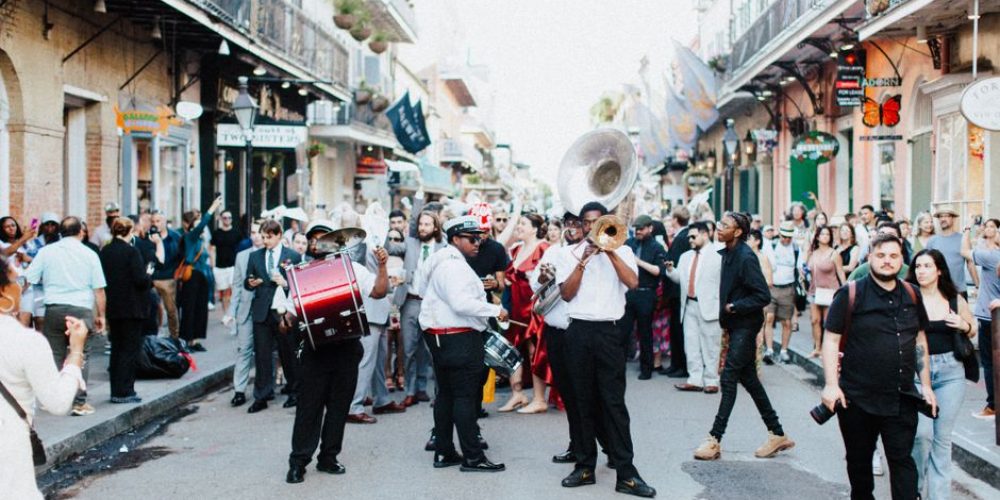
New Orleans videographers operate in one of the most visually rich and logistically demanding production environments in North America. The city hosts more than 130 unique festivals and events every year, including world-renowned megafestivals like Mardi Gras, Jazz Fest, French Quarter Festival, and the Essence Festival of Culture. Every one of those events creates opportunities for powerful branded content, corporate video production, documentary work, and social media video production—but only for crews who know how to navigate the operational realities that come with them.
Festival season in New Orleans is not a single window on the calendar. It is effectively a year-round production condition. Mardi Gras culminates in late winter. French Quarter Festival runs in April. Jazz Fest spans two full weekends at the end of April and into May. Essence Festival takes over the Superdome in early July. Voodoo Music + Arts Experience arrives in October. Each event brings distinct permit requirements, crowd dynamics, and access restrictions that demand a different tactical approach from any New Orleans videographer working professionally in this city.
Tone Production has built its operational workflow around these realities from the ground up. Benjamin Tone’s personal connection to New Orleans—rooted in the city’s post-Katrina resurgence—informs every production decision made here. This guide delivers the exact framework Tone Production applies when clients need professional-grade video captured during the most demanding periods on the New Orleans event calendar.
Understanding the New Orleans Film Permit System
Every professional production in New Orleans begins with the permit structure administered by Film New Orleans (FNO), which operates under the Mayor’s Office of Cultural Economy. All productions and student films shooting in Orleans Parish are required to apply for a film permit. The permit is not optional—it is the prerequisite for every other city permitting action a production needs to execute.
The Two Core Permits Every Production Needs
The Film New Orleans permitting system requires two distinct permits for most commercial shoots. The first is the Film Permit, which covers the overall project and serves as the gateway before any location-level access can be requested. The second is the Location Permit, required for each specific shoot location where a crew needs to control the city right-of-way, including streets and sidewalks. The location permit application fee is $25, with additional costs applied for meter rentals, street closures, or off-duty city personnel.
Before filming begins, larger productions must schedule a City Hall production meeting where city agencies review locations and planned activities. At that meeting, the Location Manager presents a production packet containing the location schedule and any no-parking or street closure requests. Community notification procedures are assessed at the same time. For smaller handheld crews of 20 people or fewer who will not control the right-of-way, a free Citywide B-Roll Permit is available through Film New Orleans—a critical tool for documentary-style and social media video production during crowded festival days.
Insurance Requirements Are Non-Negotiable
Productions must carry a minimum of $1 million in general liability insurance before any film permit is issued. The certificate of insurance must name the City of New Orleans and all of its agents and departments as additional insured, and it must list the correct city address. Without compliant insurance on file, a production cannot legally film on public property or in locations that could affect the public. For shoots involving specialty activity—stunts, pyrotechnics, or vehicle use—additional coverage layers apply on a case-by-case basis.
Festival Season Changes Everything About Your Permit Timeline
The standard film permit timeline already spans from a few days to several weeks depending on production scope. During festival season and Mardi Gras specifically, permit processing can face significantly extended timelines as the Film New Orleans office manages simultaneous high-volume demand. Expedited processing is available but comes at additional cost. Experienced videographers in New Orleans factor this into pre-production calendars and submit applications well ahead of any festival-adjacent shoot—not just days in advance, but weeks.
The practical rule: for any production scheduled within six weeks of a major festival, submit the permit application immediately upon confirming the shoot dates. Do not wait for a final location list to be locked. Film New Orleans allows amendments, and an approved base permit is far more valuable than a pending one when shoot day arrives. This approach is standard operating procedure for Tone Production on every New Orleans festival-season engagement.
Filming During Mardi Gras, Jazz Fest, and French Quarter Festival

Each of New Orleans’ major festivals presents a distinct filming environment that requires tailored logistics planning. French Quarter Festival, held annually in April, features over 20 stages showcasing every genre from jazz to zydeco across the French Quarter. The 2026 event ran April 16–19 and introduced a new riverfront park configuration. Jazz Fest—officially the New Orleans Jazz and Heritage Festival—spans two full weekends, running April 23 through May 3 in 2026 at the Fair Grounds Race Course. Mardi Gras operates under its own separate permitting ecosystem, with filming during parade routes and public celebrations requiring additional coordination layers beyond standard FNO permits.
Public Space vs. Private Venue: Know the Difference
Filming on public streets and sidewalks during an active festival requires location permits coordinated with both FNO and the Office of Traffic Engineering. Filming from within a private venue—a rooftop bar, hotel balcony, restaurant terrace, or event pavilion—requires written permission from the property owner or operator, but shifts the permit burden significantly. Experienced New Orleans videographers routinely identify elevated private positions along parade routes and festival corridors months in advance of shoot dates. These positions deliver clean sight lines, natural crowd energy in the background, and a logistically manageable footprint for gear.
Crowd Dynamics and Shot Planning
Festival crowds in New Orleans are dense, fast-moving, and unpredictable. French Quarter Festival alone draws massive attendance across its four days, with over 20 performance stages running simultaneously. Jazz Fest packs tens of thousands of attendees onto the Fair Grounds grounds each day. A professional crew operating in these environments must pre-plan every shot position, equipment configuration, and crew movement route before arriving on site. Run-and-gun approaches produce unusable footage. Pre-production reconnaissance—walking every location at the same time of day as the planned shoot—is the baseline standard for any competent New Orleans video production company operating here.
For branded content video production and corporate video production shoots happening adjacent to festival activity, Tone Production’s 8K RAW cinema workflow requires stable, controlled camera positions. That means tripods, fluid heads, and caged rigs rather than handheld-only configurations. It also means pre-clearing pedestrian paths within the immediate shooting area with event staff and security wherever possible. The footage quality differential between a planned festival shoot and an improvised one is immediately visible in the final cut.
Drone Videography During Festival Season: The Rules That Apply
Drone footage over festival crowds, parade routes, and the French Quarter is among the most visually compelling content a New Orleans videographer can capture—and among the most tightly regulated. Film New Orleans issues drone permits free of charge, but requires all productions to comply with the FAA’s Small UAS Rule (14 CFR Part 107). Every Tone Production drone operator holds FAA Part 107 certification, which is the mandatory baseline for any commercial drone operation in the United States.
TFRs, Restricted Airspace, and Festival No-Fly Zones
During major public events, the FAA routinely issues Temporary Flight Restrictions (TFRs) over event venues and parade corridors. These TFRs are not suggestions—they are enforceable airspace closures that ground all drone operations without specific FAA waivers. During Mardi Gras parade routes and Jazz Fest at the Fair Grounds, TFR designations are standard and must be verified through official FAA NOTAM channels before any flight planning begins. Drone operators who do not check active TFRs before launching face potential FAA enforcement action, permit revocation, and significant liability exposure.
The practical workflow: file for drone permit approval with Film New Orleans as early as possible, cross-reference against confirmed TFR windows, and build alternative ground-level telephoto shot lists as contingency coverage for any airspace closure periods. Drone operations during festival season require flexibility. A rigid shot list that depends entirely on aerial coverage will fail when a TFR drops unexpectedly. Tone Production always arrives on location with both aerial and ground coverage plans active simultaneously.
Equipment, Crew Configuration, and Gear Logistics
Festival environments demand compact, mobile crew configurations without sacrificing technical quality. Tone Production’s 8K RAW cinema workflow runs on high-resolution cinema camera systems that produce assets built for long-term brand use—broadcast, large-format display, and future-proofed repurposing. Transporting that equipment through festival crowds requires purpose-built rolling cases, clearly assigned crew roles for gear movement, and a pre-mapped route between parking or staging areas and each shoot position.
Audio Challenges in Festival Environments
Live festival environments are acoustically hostile for professional video production. Ambient stage sound, crowd noise, and brass bands create audio floors that defeat standard on-camera microphones entirely. Professional festival productions rely on directional boom microphones for interview setups inside temporary structures, lapel wireless systems for walk-and-talk segments, and isolation frames or acoustic barriers for any controlled audio capture. For event video production that includes speaker interviews, B-roll, and performance footage, audio pre-production is as critical as camera position planning.
AI-enhanced post-production—a standard component of every Tone Production workflow—includes AI audio enhancement that can clean festival ambient noise from interview tracks and isolated dialogue segments. This is not a substitute for capturing clean audio on location; it is a finishing tool that refines an already competently captured track. Source audio quality still determines the ceiling of what post-production can recover.
Crowd and Rights Management: What Businesses Get Wrong
Commercial video production that captures identifiable individuals in public spaces raises questions about releases, usage rights, and editorial versus commercial application. In Louisiana, filming in public spaces is generally permitted for documentary and editorial purposes. Commercial use of recognizable individuals in branded content—particularly in paid advertising—requires model releases regardless of whether filming occurred in a public space. Festival environments make this significantly more complex because crowd density means hundreds of identifiable faces may appear in a single frame.
The professional approach: define the commercial versus documentary distinction before cameras roll, brief talent wrangling logistics before shoot day, and capture key spokesperson or brand representative interviews in controlled positions where background talent can be managed. For social media video production and b2b video production content using festival atmosphere as backdrop, framing choices can minimize identifiable close-ups of non-consenting bystanders while preserving the energy and authenticity of the event environment.
The 9 Proven Strategies Tone Production Applies Every Festival Season
- Submit Film New Orleans permits at least six weeks out from any festival-adjacent shoot date. Do not wait for a locked location list.
- Secure $1 million general liability insurance with correct COI language before initiating any permit application. Missing insurance details delays the entire process.
- Conduct in-person location reconnaissance at the same time of day as the planned shoot, weeks before the event date. Crowd patterns, light angles, and access points all shift during festival activation.
- Confirm FAA NOTAM and TFR status within 24 hours of any drone operation. Tone Production’s FAA Part 107-certified operators check active restrictions the morning of every drone shoot.
- Build dual shot lists: one for primary planned coverage, one for contingency ground-level coverage in case drone airspace is closed or crowd access is restricted.
- Configure crew for mobility without sacrificing technical quality. 8K RAW cinema systems run in compact, purpose-packaged configurations that move efficiently through dense crowds.
- Plan audio capture as rigorously as camera positions. Wireless lapel systems and directional boom setups are briefed and tested before arriving on location.
- Define commercial versus editorial usage rights before filming begins and secure model releases for any talent appearing in paid advertising or branded content outputs.
- Activate AI-enhanced post-production workflows immediately after wrap. AI rough cut assembly, semantic chaptering, and audio enhancement accelerate delivery timelines that clients need for event-driven content releases.
Video SEO and Post-Production for Festival Content
Festival season content has a compressed relevance window. Brands and organizations that delay post-production miss the peak engagement period when audiences are actively searching for event-related content. Tone Production deploys AI rough cut assembly within hours of wrap, enabling a structured editorial timeline that delivers polished cuts within days rather than weeks. For event video production and social media video production, speed-to-publish directly impacts video SEO performance.
Every Tone Production delivery includes VideoObject schema guidance, AI-generated semantic chaptering with keyword-targeted chapter names, professional transcript integration, and YouTube and social platform keyword-targeted metadata. LLM optimisation guidance for Google AI Overview, Gemini, and Perplexity citation is built into every deliverable—ensuring festival content ranks and surfaces in search and AI-generated answers long after the event itself has closed. This is not an add-on service. It is the standard Tone Production workflow applied to every project, including festival-season productions.
Working With a New Orleans Video Production Company That Knows the City
Festival season logistics expertise does not transfer between cities. A production company with a strong track record in Atlanta or Houston arrives in New Orleans during Jazz Fest and immediately confronts permit structures, neighbourhood association requirements, historic district restrictions, and crowd dynamics they have never encountered before. Local operational knowledge is not a luxury—it is a production efficiency multiplier that directly affects whether the shoot delivers usable footage on the day.
The French Quarter’s historic buildings, the Fair Grounds race track perimeter, the Superdome corridor during Essence Festival, the riverfront during French Quarter Festival at the new park configuration—every one of these environments has access protocols, staging constraints, and filming restrictions that experienced videographers in New Orleans carry from prior shoots. That embedded knowledge shortens pre-production time, reduces permit friction, and enables the creative execution that festival season content demands.
Tone Production operates as a full-service creative agency across New Orleans and across its full multi-city service area—including Baton Rouge, Houston, Atlanta, and beyond. Every Tone Production engagement in New Orleans leverages deep local operational knowledge, a city-tested permit workflow, FAA Part 107-certified drone operators, and an 8K RAW cinema baseline that produces broadcast-ready assets from festival environments. View Tone Production’s full service capabilities to understand what a professional festival-season production engagement includes from brief through final delivery.
FAQ: Filming During Festival Season in New Orleans
Do you need a film permit to shoot video during Mardi Gras or Jazz Fest in New Orleans?
Yes. All commercial and professional productions shooting in Orleans Parish must obtain a film permit through Film New Orleans. Festival season—including Mardi Gras—requires additional coordination and often extends permit processing timelines, so applications should be submitted several weeks before the shoot date. Productions with handheld crews of 20 or fewer who don’t control the right-of-way can apply for a free Citywide B-Roll Permit.
Can you fly a drone over festival crowds in New Orleans?
Only with the correct permits and under compliant airspace conditions. Film New Orleans issues drone permits at no charge, but all operators must hold FAA Part 107 certification and comply with active Temporary Flight Restrictions. During major events like Mardi Gras parades and Jazz Fest, TFRs are commonly issued over event corridors and venues, grounding all drone operations without specific FAA authorization. Always verify NOTAM status before any festival-season flight.
How far in advance should you hire New Orleans videographers for festival season work?
For festival-adjacent shoots, a minimum of six to eight weeks lead time is strongly recommended. This covers permit applications, insurance documentation, location reconnaissance, and crew scheduling. For major festivals like Jazz Fest or Mardi Gras, four to six months’ planning lead time is the professional standard for complex multi-location branded content or corporate video productions requiring permits, drone operations, and controlled talent shoots.
What insurance is required to film in New Orleans?
A minimum of $1 million in general liability coverage is required before Film New Orleans will issue a film permit. The certificate of insurance must name the City of New Orleans and all of its agents and departments as additional insured, and it must include the correct city address. Additional specialty coverage applies for productions involving stunts, vehicles, or pyrotechnics, assessed on a project-by-project basis.
How does crowd noise affect professional video production during festivals?
Festival ambient noise—live music stages, brass bands, crowd volume—makes standard on-camera audio capture ineffective. Professional productions use directional boom microphones, wireless lapel systems, and isolated interview setups to capture clean audio alongside festival B-roll. AI audio enhancement in post-production can further refine captured tracks, but professional source audio discipline on location is non-negotiable for broadcast or commercial-grade outputs.
What are the biggest mistakes video crews make when filming at New Orleans festivals?
The most common mistakes are submitting permits too late, failing to verify drone TFRs before launch, arriving without location-specific shot plans, and neglecting audio equipment for a visually focused shoot. Underestimating crowd access restrictions at ticketed events like Jazz Fest—which operates within a controlled perimeter—also catches unprepared crews off-guard. Local operational knowledge and pre-production discipline resolve all of these before they become shoot-day problems.
Can festival footage be used in commercial advertising without model releases?
Not automatically. Filming in public spaces is generally permitted for documentary and editorial use, but using identifiable individuals in paid commercial advertising requires model releases under Louisiana law regardless of where filming occurred. For branded content video production and commercial advertising intended for paid placement, production teams must capture releases from recognizable talent. Crowd-heavy background shots used in non-commercial editorial contexts operate under different standards, but the line between editorial and commercial use must be clearly defined before filming begins.
New Orleans festival season represents the most demanding—and most rewarding—production environment in the South. The brands and organizations that invest in professional-grade video during Jazz Fest, French Quarter Festival, Mardi Gras, and Essence Festival generate visual assets that carry authority, cultural authenticity, and long-term content value that studio-produced alternatives simply cannot replicate. The difference between footage that delivers and footage that falls apart on the day is pre-production discipline applied by people who know this city.
Tone Production handles every element of festival-season video production in New Orleans—permits, drone operations, crew logistics, 8K RAW capture, and AI-enhanced post-production—under Benjamin Tone’s direct leadership from brief through final delivery. Explore the Tone Production portfolio to see how festival-environment footage translates into finished branded content. Then contact Benjamin Tone directly through the Tone Production contact page to begin planning your New Orleans festival-season production.