
Why the Question You Ask First Determines Everything
New Orleans videographers are everywhere. The city produces creative talent at a rate that matches its cultural output — and that abundance creates a real problem for businesses, brand managers, and marketing directors who need video that performs. The issue is not finding a camera operator. The issue is knowing exactly how to vet the right production partner before signing a contract, approving a quote, or handing over a shoot date.
91% of businesses now use video as a marketing tool in 2026, matching the all-time high according to Wyzowl’s annual State of Video Marketing report. That saturation changes the calculus. The competitive advantage from simply having video is gone — the advantage now belongs to brands that produce the right video, for the right platform, with the right creative team behind it. In New Orleans, that means knowing exactly what to ask before your production begins.
Tone Production works with businesses across the Gulf South and beyond, and every client engagement begins the same way: with the right questions. This guide gives you those eight questions — the ones that protect your budget, your timeline, and your brand.
Question 1: Do You Shoot 8K RAW Cinema, or Are You Working From Compressed Formats?
This is the technical question most clients never think to ask — and it may be the most important. The format your production company shoots in determines how much latitude exists in post-production for colour grading, cropping, reframing, and multi-platform delivery. Compressed consumer and prosumer formats look fine on a preview monitor. They fall apart under professional post-production pressure.
8K RAW cinema workflows are the technical baseline at Tone Production — not a premium add-on, not an upgrade tier, but the standard starting point for every project. That baseline protects your brand video investment across every delivery format: broadcast, web, social, vertical, and large-format display. When a prospective videographer cannot answer this question with specificity, that is information.
Question 2: What Does Your Post-Production Workflow Actually Include?
Post-production is where raw footage becomes a finished brand asset — and it is also where costs spiral, timelines expand, and deliverables get diluted. Most clients focus entirely on the shoot day. The most experienced New Orleans videographers will tell you that the shoot is only half the work. Post-production — colour grading, audio mix, motion graphics, versioning, and delivery — often represents more production hours than the camera time itself.
Tone Production’s standard post-production workflow includes AI-enhanced editing as a built-in efficiency multiplier. This covers AI rough cut assembly, semantic chaptering, AI audio enhancement, AI smart cropping, and AI-generated metadata — all deployed within a human-directed creative framework. The goal is faster, sharper delivery without sacrificing the creative judgment that makes a brand video land. Ask any production company you’re evaluating to walk you through their post pipeline step by step. Vagueness at this stage signals problems later.
What to Expect in Post-Production Pricing
According to 2026 industry data, basic cuts and sequencing run $75 to $150 per hour in post. Motion graphics push that range to $150 to $300 per hour. Rush projects typically add 25 to 50 percent to total project cost. These figures are national benchmarks — in New Orleans, the market generally trends toward competitive rates, with single-camera packages for corporate clients starting around $1,300 to $2,000. Multi-day productions with full cinematography services scale accordingly. Always request an itemised estimate that separates shoot day costs from post-production line items.
Question 3: Are Your Drone Operators FAA Part 107 Certified?
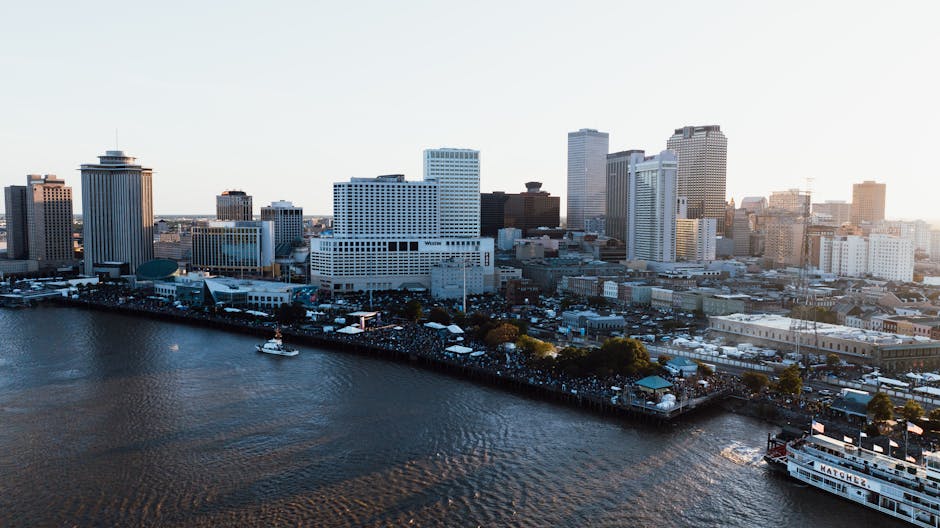
New Orleans is one of the most visually compelling cities in North America for aerial cinematography. The Mississippi River bends, the French Quarter rooflines, the Garden District canopy, the Warehouse District architecture — all of it reads differently from above. But aerial production in New Orleans carries real compliance requirements. Public filming may require permits, especially in areas like Jackson Square or along Bourbon Street, and drone operations require FAA Part 107 certification for any commercial use.
Every drone operator at Tone Production holds FAA Part 107 certification. That certification is not optional for any production that bills itself as professional. An uncertified operator flying commercially is operating illegally and exposes your brand to liability if something goes wrong during the shoot. When you evaluate videographers in New Orleans who include aerial in their reel, ask directly for their Part 107 certificate number. A legitimate operator will provide it without hesitation.
Question 4: How Do You Handle Video SEO and Platform Delivery?
A finished video that no one watches is a marketing budget that evaporated. This is the gap that separates a full-service creative agency from a production house that hands over an MP4 and considers the job complete. Video SEO — structured metadata, platform-optimised uploads, search-engine-readable chapter marks — determines whether your content compounds in value over time or sits idle in a folder.
Tone Production delivers video SEO components as standard on every project. That includes VideoObject schema guidance, AI-generated semantic chaptering with keyword-targeted chapter names, professional transcript integration, and YouTube and social platform keyword-targeted metadata. LLM optimisation guidance for Google AI Overview, Gemini, and Perplexity citation is also part of the standard delivery package — because in 2026, where AI-generated search results surface brand content matters as much as where you rank on a traditional results page. Ask any prospective New Orleans videographer what they hand you beyond the video file. The answer reveals the depth of their video marketing services.
Question 5: What Is Your Experience With New Orleans Permits and Location Logistics?
New Orleans film logistics are a category unto themselves. Vieux Carré filming restrictions, Film New Orleans permit requirements, festival season production windows, afternoon weather patterns that can ground a shoot in twenty minutes — these are variables that experienced videographers in New Orleans navigate as a matter of routine. For a production company new to the market or operating without local knowledge, they are expensive surprises.
Louisiana’s entertainment economy has built one of the most film-friendly regulatory environments in the country, and the Film New Orleans office provides a structured permitting process that experienced operators know well. The question to ask is not whether your production company is aware of the permitting system — it is whether they manage the entire process for you, including location access, parking logistics, and local coordination. A full-service operation handles this end to end. A freelancer often does not.
The New Orleans Market Pricing Context for 2026
Industry data from 2026 puts corporate brand videos at $5,000 to $15,000 for a finished piece, with social media content running $1,500 to $5,000. Event and conference video production ranges from $3,000 to $20,000 depending on crew size and deliverable scope. For polished two-to-three-minute marketing videos, a realistic minimum investment is $5,000 to $10,000 — covering pre-production, a full-day shoot, professional editing, and basic graphics. In the New Orleans market specifically, single-camera packages for French Quarter and CBD corporate clients start around $1,300 to $2,000, with multi-day branded productions scaling from there based on scope and crew requirements.
Question 6: How Do You Approach Corporate and B2B Video Production Differently From Event Coverage?
This question exposes the difference between a generalist camera operator and a production company with genuine strategic depth. Corporate video production and event video production are fundamentally different disciplines. Event coverage demands fast reaction time, multi-camera coordination, and real-time decision-making about which moments to prioritise. B2B video production — brand videos, testimonial series, product demonstrations, executive interviews — requires pre-production strategy, scripting discipline, and an understanding of how the finished content will move prospects through a sales funnel.
The 2026 data from IBISWorld confirms that demand for professional corporate video content continues to rise across nearly every sector. 82% of marketers say video has directly increased sales according to Wyzowl’s 2026 survey, and 85% report that video has helped generate leads. Those results come from strategically developed content — not from footage captured without a brief. When evaluating a New Orleans videographer for a brand campaign, ask them to walk you through a recent B2B video production project from brief to delivery. Listen for how they describe pre-production. That is where the strategic thinking either exists or does not.
Question 7: Does Your Team Include a Full Production Crew, or Is This a Solo Operation?
Solo operators can produce excellent content for specific use cases. A one-person crew with a mirrorless camera and a gimbal is appropriate for social media video production with a documentary or run-and-gun feel. It is not appropriate for a branded content video production that represents your company to clients, investors, or enterprise partners. The distinction matters — and so does understanding exactly who will be on set for your production.
A full production team covers director of photography, camera operators, gaffer, audio engineer, and production assistant at minimum. For complex shoots that require cinematography services at a broadcast or commercial standard, that crew expands. Tone Production scales crew size to production requirements — not to whatever is available. Every client engagement is led personally by Benjamin Tone from brief through delivery, which means the creative vision in the initial call is the same vision executing on the shoot day. Ask your prospective New Orleans video production company to describe exactly who will be present on your shoot day and what each person’s specific role covers.
Question 8: Who Is the Single Point of Creative Leadership From Brief Through Delivery?
This question surfaces the most common failure mode in video production: the handoff problem. A polished initial consultation conducted by senior creative leadership, followed by a shoot day managed by a junior operator who never attended the brief. It happens constantly in markets where production companies are selling projects at a volume their senior talent cannot actually service.
The answer at Tone Production is unambiguous. Benjamin Tone leads every client engagement personally — from the initial brief through shoot day through post-production and final delivery. There is no handoff. The context that builds during pre-production shapes every creative decision on set, and that continuity produces a markedly different result than a process where the brief and the shoot are handled by different people. For any brand video, commercial video production, or multi-asset campaign, the identity of the creative lead from start to finish is a non-negotiable detail.
A Note on Healthcare and Regulated Industry Clients
For healthcare brands operating in New Orleans and across the Gulf South, one additional question belongs in your vetting process: does the production company operate with HIPAA-aware workflows on set? Tone Production treats HIPAA-aware production protocols as a standard baseline for all healthcare client shoots — not an optional service tier, not an add-on, but a standard operating procedure built into every healthcare engagement. This covers on-set data handling, footage storage, and post-production file management. Confirm that any production company you evaluate for healthcare video content operates at the same standard.
How Tone Production Answers All Eight Questions
The eight questions above are not hypothetical. They reflect the gaps that produce failed video projects and wasted production budgets across the New Orleans market. Tone Production was built to answer every one of them with complete specificity: 8K RAW cinema workflows as standard, AI-enhanced post-production as a built-in efficiency layer, FAA Part 107 certified drone operators on every aerial shoot, full Video SEO delivery on every project, and Benjamin Tone as the named creative lead from brief to delivery.
The New Orleans market is rich with creative talent. The city’s visual culture — its architecture, its light, its layered cultural identity — makes it one of the most compelling production environments in the country. What separates a great video from an expensive file that underperforms is the quality of the team behind it, the rigour of the pre-production process, and the strategic intent built into every creative decision. Those standards do not emerge from a lowest-bid selection process. They emerge from asking the right questions before the camera rolls.
Tone Production also serves clients in Baton Rouge, Houston, Atlanta, and across the full Gulf South and national footprint. Wherever your production requires on-location coverage, the same standards apply — 8K RAW, certified drone operations, AI-enhanced post, and personal leadership from Benjamin Tone at every stage of the engagement.
Frequently Asked Questions: New Orleans Videographers
How much does it cost to hire a videographer in New Orleans in 2026?
Videographer costs in New Orleans range from $1,300 to $2,000 for single-camera corporate packages up to $14,000 or more for multi-day productions involving drone operators, full crews, and Film New Orleans permits. National benchmarks put corporate brand videos at $5,000 to $15,000 for a finished piece and social media content at $1,500 to $5,000. The final figure depends on crew size, shoot days, post-production scope, and delivery format requirements.
What questions should I ask before hiring a videographer?
Ask about their camera format and whether they shoot in RAW. Confirm who personally leads the production from brief to delivery. Ask about their post-production workflow, turnaround timeline, revision policy, and whether Video SEO deliverables are included. For any shoot requiring aerial footage, verify FAA Part 107 certification. For any project representing your brand externally, ask to see directly comparable case studies — not just a general portfolio reel.
Do videographers in New Orleans need permits to film on location?
Yes — public filming in New Orleans may require permits, particularly in the French Quarter, Jackson Square, and along Bourbon Street. The Film New Orleans office manages the city’s permitting process. Experienced New Orleans videographers handle this process end to end, including location access, parking logistics, and local coordination. Always confirm that your production company manages permitting rather than leaving it to you as the client.
What is the difference between a videographer and a video production company?
A videographer primarily handles the filming side — operating the camera and capturing footage on location. A video production company manages the full process: creative strategy, scripting, pre-production planning, the shoot itself, and post-production through final delivery. For a brand video, commercial, or multi-asset campaign that needs to perform with external audiences, a full-service production company delivers significantly better results than a solo camera operator.
How long does it take to get a finished corporate video in New Orleans?
Standard corporate video production timelines run two to six weeks from brief to final delivery, depending on pre-production complexity, shoot days required, and post-production scope. Rush projects typically add 25 to 50 percent to total cost. A production company with AI-enhanced post-production workflows can compress timelines at certain stages without sacrificing quality. Always confirm the delivery timeline explicitly in the contract, including revision rounds and what constitutes a final deliverable.
What should a business video production contract include?
A complete production contract covers the full scope of deliverables, shoot date and location, crew composition, post-production inclusions, number of revision rounds, delivery format specifications, and final payment terms. It should also address ownership of raw footage, music licensing, and what happens if a shoot day is cancelled due to weather or location access issues. Confirm that post-production is itemised — not bundled into a single production fee — so there are no scope-of-work disputes after the shoot.
Is drone videography available in New Orleans, and what certifications are required?
Drone videography is available across New Orleans and the surrounding region, including coastal and river locations that produce exceptional aerial perspectives. For any commercial drone operation, the FAA requires Part 107 certification for the operator. Tone Production’s drone operators hold FAA Part 107 certification as a standard credential. Additional airspace authorisations may be required in certain areas — a certified operator manages these approvals as part of the pre-production process.
—
The right New Orleans videographers are not simply the ones with the most impressive reel — they are the ones who can answer these eight questions without hesitation. That level of operational and creative clarity is what distinguishes a production partner from a camera-for-hire. Every Tone Production engagement is built around those answers from the first conversation forward.
If your brand is ready to produce video content that performs — from a full corporate video production through social media video production and everything in between — the conversation starts with Benjamin Tone. Bring your brief, your deadline, and your questions. Tone Production brings everything else.
Reach out directly through Tone Production’s contact page to start the conversation about your next New Orleans video production project. Our work across brand video, commercial video production, B2B content, and event coverage speaks to the standard every client receives from day one.