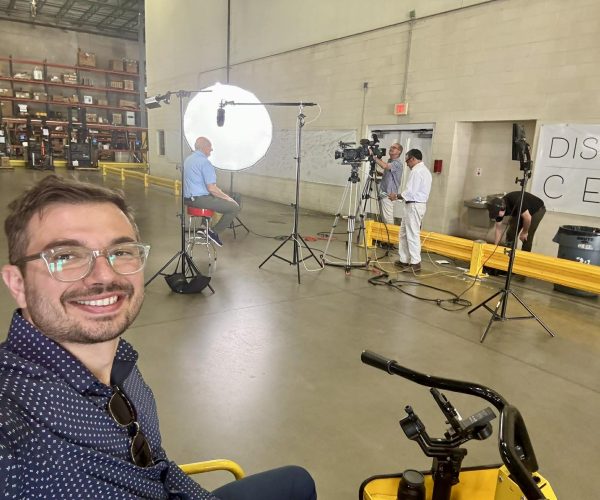
Video SEO is not something that happens after a video is produced and uploaded. The optimisations that determine whether a business video ranks on Google, surfaces in YouTube search, appears in AI-generated answers, and captures the rich snippet positions that drive the highest click-through rates — most of them are determined by decisions made at the production and post-production stage, before the video is ever published. As an Atlanta video production company, Tone Production builds video SEO optimisation into every workflow as a standard deliverable — not as an optional add-on. This guide breaks down the nine strategies that determine whether Atlanta business video performs in search or disappears into an upload queue.
Why Video SEO Is the Highest-Leverage Channel for Atlanta Businesses in 2026
The relationship between video and search has shifted from supplementary to structural. According to AutoFaceless.ai’s April 2026 video SEO statistics research, more than 25% of all Google search results now feature a video snippet. A landmark Milestone Research study analysing 4.5 million queries found that rich results — including video rich snippets — achieved a 58% click-through rate compared to 41% for non-rich results. That 17-percentage-point advantage means pages qualifying for rich results through video and structured data capture significantly more traffic from the same ranking position than competitors without video.
For Atlanta businesses competing in financial services, technology, healthcare, and professional services — sectors where Google search visibility drives the majority of new client acquisition — this translates directly into competitive positioning. SEOLEVELUP’s 2026 video SEO analysis reveals that only 34% of creators implement video SEO systematically, despite 78% recognising its importance. That implementation gap represents the specific opportunity available to Atlanta businesses that commit to the nine strategies below. Tone Production, founded and led by Benjamin Tone, builds all nine of these strategies into every production workflow as production decisions, post-production deliverables, and publishing guidance — treating video SEO as an integral part of what a professional Atlanta video production company delivers.
Strategy 1 — Implement VideoObject Schema on Every Page With Embedded Video
VideoObject schema is the structured data markup that tells Google explicitly what a video contains — its title, description, thumbnail URL, upload date, duration, and content summary. Without it, Google may not identify an embedded video as indexable content even when the video itself is high quality and the surrounding page content is strong. With it, the video qualifies for rich snippet treatment in search results — the thumbnail, duration, and clickable timestamp display that captures dramatically more visual real estate than a standard blue link.
According to VdoCipher’s 2026 Video SEO Best Practices guide, VideoObject schema enables videos to appear as rich snippets with thumbnail, duration, and clickable key moments directly in Google results. AutoFaceless.ai’s 2026 research confirms that videos with VideoObject schema are seeing significant jumps in Answer Share of Voice in Google’s AI Overviews. Implementation requires adding the schema markup to the page code where the video is embedded — either through a WordPress SEO plugin like Rank Math or Yoast, or through manual JSON-LD implementation in the page header. Tone Production delivers VideoObject schema guidance and the complete metadata required to populate it as a standard component of every Atlanta client’s post-production package.
Strategy 2 — Optimise Video Titles for the First 60 Characters on Both Platforms
The video title is the primary ranking signal on YouTube and the most visible element in Google rich snippets. Getting the title structure right is the highest-impact metadata decision available. According to Wildnet Technologies’ 2026 YouTube SEO analysis, placing the primary keyword within the first 60 characters of a title generates 8.3% higher click-through rate than titles with the keyword placed later. The formula that consistently performs is primary keyword first, followed by a hook or benefit statement, kept under 60 characters for full visibility before mobile truncation.
For Atlanta businesses producing corporate video, the keyword strategy differs between Google and YouTube. Google video titles should target exact match phrases that business clients search — “Atlanta corporate video production,” “brand video Atlanta,” “video production cost Atlanta.” YouTube titles for the same content should incorporate longer, more specific queries that match YouTube’s search behaviour — “How Atlanta brands use corporate video to win enterprise clients 2026.” According to Semrush’s 2026 YouTube Research, only 41% of high-volume Google keywords translate to high-performing YouTube search terms — meaning separate title strategies for each platform consistently outperform a one-size-fits-all approach. Benjamin Tone develops platform-specific title strategies as part of the distribution guidance Tone Production provides for every Atlanta client’s video content.
Strategy 3 — Build Semantic Chapter Markers Into Every Video
Semantic chaptering — adding precisely named timestamp markers to video content — is one of the highest-impact technical video SEO actions available in 2026. According to AutoFaceless.ai’s research, YouTube announced testing in April 2025 of AI Overview video carousels that display relevant portions of videos directly in Google search results. Rather than showing full videos, this feature surfaces the most relevant segments — fundamentally changing video SEO by rewarding content with clearly structured chapters that answer specific queries within defined time windows.
The implementation standard for 2026 is specific. Chapters should be placed every 90 to 120 seconds and named with keywords that match real search queries rather than generic descriptive labels. A chapter named “How video SEO works in 2026” performs better in AI Overview extraction than a chapter named “Section 2” or “Background.” SEOLEVELUP’s 2026 analysis confirms that adding timestamps and chapters that include natural keyword phrases delivers better navigation and search visibility simultaneously.
This is a production planning decision as much as a publishing decision — videos without clearly structured narrative segments cannot be chaptered effectively because there are no distinct topic boundaries to mark. Tone Production scripts every video with defined narrative architecture from which meaningful semantic chapters are derived, ensuring the SEO value of chaptering is built into the content before the camera rolls.
Strategy 4 — Write Descriptions of 200 Words or More With Front-Loaded Keywords
YouTube truncates descriptions after the first 125 characters in search results — which means the primary keyword and the core value proposition must appear within the first two sentences before the “show more” cut. But the full description length matters for both YouTube’s indexing algorithm and for providing the contextual text that Google uses to understand and rank the video. JCT Growth’s 2026 YouTube SEO research confirms that a strong description typically includes at least 200 to 300 words of keyword-aligned, contextual content that expands on the video topic.
The correct description structure for an Atlanta business video includes the primary keyword in the first sentence, a 2 to 3 sentence summary of the video’s core content and value, a paragraph expanding on the topic with secondary keywords integrated naturally, links to relevant website pages, social channel links, and a call to action. For corporate videos produced by Tone Production for Atlanta clients, the description also serves as the primary text that AI systems including Google Gemini, ChatGPT, and Perplexity parse when deciding whether to reference the video in generated answers.
A rich, well-structured description increases AI citation potential significantly above a thin two-sentence description that leaves AI systems with insufficient context to assess the video’s authority on its claimed topic.
Strategy 5 — Publish Accurate Professional Transcripts — Never Rely on Auto-Generation
Transcripts are the mechanism through which every word spoken in a video becomes indexable text for Google and YouTube. According to VdoCipher’s 2026 best practices guide, transcripts turn spoken content into readable text, meaning search engines can understand every word, topic, and keyword mentioned in the video. When a transcript is crawlable, AI-driven systems including ChatGPT and Perplexity can also pick up context and reference the video content in their summaries.
The implementation warning that most Atlanta businesses ignore: never rely solely on YouTube’s automatic transcription. SEOLEVELUP’s 2026 analysis confirms that auto-transcription is frequently inaccurate and can harm topical authority by introducing errors into the text Google uses to understand the video’s content. A transcript that misidentifies technical terms, proper names, or industry-specific language signals to Google that the content is lower quality than it actually is. Professional transcription — accurate, keyword-aligned, and structured with correct punctuation — is the correct standard. Tone Production delivers professionally edited transcripts as a standard component of every post-production package for Atlanta clients, with keyword alignment reviewed against the target search queries the video is designed to capture.
Strategy 6 — Optimise Thumbnails for 90% Custom Usage and Maximum CTR
Click-through rate is a direct ranking signal on YouTube — when more people click a video after seeing it in search results, YouTube’s algorithm treats that as evidence the video matches user intent and rewards it with higher visibility. The thumbnail is the single element with the most direct influence on CTR. According to Wildnet Technologies’ 2026 analysis, 89% of top-ranking videos use custom thumbnails rather than auto-generated frames. Face plus text thumbnails generate 30% to 50% CTR lift compared to generic thumbnails without faces. High contrast — white text on dark backgrounds or vice versa — performs consistently above low-contrast combinations.
For Atlanta corporate and B2B video content, thumbnail strategy requires a different approach than entertainment content. Business audiences respond to thumbnails that signal professional authority and specific informational value — an executive’s face with a clear text overlay naming the specific topic, a product or facility image with a bold value statement, or a branded graphic that communicates the video’s professional standard before the viewer ever clicks play. According to SEOLEVELUP’s 2026 research, custom thumbnails contribute to the 90% adoption rate among top-performing videos on the platform — confirming that this is not optional for Atlanta businesses treating YouTube as a serious search and distribution channel.
Strategy 7 — Optimise Watch Time and Audience Retention Through Production Quality
YouTube’s algorithm in 2026 prioritises viewer satisfaction signals above keyword density. Watch time — total minutes people spend watching a video — and audience retention — the percentage of the video watched from start to finish — are the two most heavily weighted ranking factors in YouTube’s discovery engine. According to SEOLEVELUP’s 2026 YouTube SEO research, videos with 50% or higher average view duration generally perform better in search and suggestions. Top 10% educational videos averaged 58.3% average view duration, 9.7% CTR, and 6.2 minutes of absolute watch time.
This is precisely where professional production quality becomes a direct SEO input rather than just a brand consideration. A poorly edited video with weak audio, flat lighting, and no clear narrative structure loses viewers in the first 30 seconds — generating the low retention rates that YouTube’s algorithm penalises with reduced distribution. A professionally produced video with cinema-grade visuals, clean audio, strong scripting, and deliberate pacing holds viewers longer — generating the retention rates that compound into algorithmic recommendation preference over time.
According to SEOLEVELUP’s research, brands optimising for YouTube search trends saw 50% growth in viewing time year-over-year over three years through this compounding mechanism. Tone Production‘s 8K RAW cinema workflows, professional spatial audio, and strategic narrative scripting are not just production quality standards — they are direct inputs to the watch time and retention metrics that determine YouTube ranking.
Strategy 8 — Build for LLM Visibility: Optimising for AI-Generated Search Results
The newest and highest-growth frontier in video SEO is LLM optimisation — structuring video content so that Large Language Models including Google Gemini, ChatGPT, and Perplexity reference and cite it when generating answers to relevant queries. According to VdoCipher’s 2026 research, AI tools like Google’s Gemini and Perplexity can now understand video content more deeply than simple metadata analysis — they can parse transcripts, captions, and spoken context to know exactly what is being said. That means the video’s actual content clarity and depth matters as much as metadata for AI citation potential.
JCT Growth’s 2026 YouTube SEO research confirms that AI systems analyse transcripts, descriptions, and structured content, with videos that clearly answer questions and demonstrate expertise more likely to be referenced in AI-generated results. The practical implications for Atlanta businesses are specific. Videos must answer clearly defined questions rather than covering topics generally. Transcripts must be accurate so AI systems can parse them reliably.
Descriptions must provide sufficient context for AI systems to assess the video’s authority on its claimed topic. Chapter markers must delineate specific question-answer segments that AI can extract as standalone responses. Every one of these requirements is a production and post-production decision that Benjamin Tone builds into every Tone Production video project for Atlanta clients from the brief stage forward.
Strategy 9 — Publish Consistently and Build Topical Authority Through Content Clusters
According to VidIQ’s 2026 research cited in Sprout Social’s YouTube SEO guide, creators who upload 12 or more times a month increase their view rate 53% faster than those who post one to three times. Consistent publishing trains both audiences and algorithms to return for more — building the channel authority signals that make every subsequent video rank faster than the previous one. For Atlanta businesses, this does not mean producing broadcast-quality brand films every week. It means a content calendar that balances higher-production-value anchor content with consistent lower-complexity educational content that maintains algorithmic presence between major production investments.
Topical authority — covering a subject so comprehensively that YouTube and Google recognise a channel or website as the definitive source on that topic — is the compound advantage that consistent publishing builds over time. An Atlanta technology company that publishes consistently on topics relevant to its specific software category builds the same kind of topical authority on YouTube that its blog builds on Google — with each new video reinforcing the rankings of existing videos in the same topic cluster.
According to JCT Growth’s 2026 analysis, the brands winning in 2026 are integrating video strategies into a holistic SEO ecosystem rather than publishing individual videos in isolation. Tone Production structures Atlanta retainer content partnerships around quarterly topic clusters that build topical authority systematically rather than producing disconnected individual pieces that compete with rather than reinforce each other.
How Much Does Video SEO-Optimised Production Cost in Atlanta in 2026
The Atlanta SEO Foundation Package: Single-day productions generating one to two SEO-optimised corporate videos — with full post-production including VideoObject schema guidance, professional transcript, semantic chapter structure, optimised description copy, and thumbnail design — typically range from $4,500 to $12,000 in the Atlanta market. This reflects Juxt Media’s 2026 Atlanta pricing research placing full-day professional corporate video production at $5,000 to $15,000 inclusive of production and post-production. The SEO optimisation components add a half-day of post-production work to the standard workflow — a meaningful investment that multiplies the search and AI visibility value of the production many times over.
The Full Video SEO Campaign: Multi-video content strategies designed to build topical authority — a hero brand film, a YouTube educational video series of four to six pieces, and a social media distribution package — with full video SEO optimisation across every piece, typically range from $15,000 to $40,000. Benjamin Tone works with Atlanta clients at this level to develop the keyword strategy, topic cluster architecture, and platform-specific title framework before any production resource is committed — ensuring the content strategy is built for search performance from the outset rather than optimised as an afterthought after the content exists.
The Ongoing Atlanta Content Partnership: Monthly retainer relationships providing consistent SEO-optimised video content — two to four pieces per month across YouTube, LinkedIn, and the website — with full video SEO delivery on every piece, typically range from $5,000 to $15,000 per month. The compounding nature of video SEO means that consistent monthly video publication builds topical authority progressively — with each new piece strengthening the rankings of existing content rather than operating in isolation. Tone Production structures Atlanta retainer partnerships around quarterly keyword and topic cluster plans that compound search authority deliberately over 12-month content calendars.

Frequently Asked Questions About Video SEO for Atlanta Businesses
What is video SEO and how does it work?
Video SEO is the practice of optimising video content so that Google and YouTube can discover, understand, index, and rank it in response to relevant search queries. It involves three distinct processes: crawling, where search bots discover video content through sitemaps, schema markup, or embedded pages; indexing, where they analyse titles, descriptions, thumbnails, and transcripts to understand the content; and ranking, where relevance, engagement signals, and page authority determine where the video appears in results. Video SEO in 2026 also encompasses LLM optimisation — structuring content for citation by AI-generated answer systems including Google Gemini, ChatGPT, and Perplexity.
What is the difference between YouTube SEO and Google video SEO?
YouTube SEO prioritises engagement signals — watch time, audience retention, click-through rate, likes, comments, and subscriber growth — alongside keyword relevance in titles, descriptions, and spoken content. Google video SEO prioritises structured data markup including VideoObject schema, page authority of the embedding page, dwell time generated by the embedded video, and the strength of the surrounding page content. According to SEOLEVELUP’s 2026 analysis, YouTube prioritises watch time and engagement velocity while Google values structured data markup and page authority. A complete video SEO strategy addresses both platforms with platform-specific optimisation rather than applying a single approach across both.
How does VideoObject schema help video rankings on Google?
VideoObject schema is structured data markup added to a webpage that tells Google explicitly what a video contains — its title, description, thumbnail URL, upload date, duration, and content summary. Without it, Google may not identify an embedded video as rankable content. With it, the video qualifies for rich snippet treatment in search results, including thumbnail display, duration information, and clickable timestamps. According to AutoFaceless.ai’s 2026 research, rich results including video rich snippets achieve a 58% click-through rate compared to 41% for non-rich results — a 17-percentage-point advantage that translates directly into more traffic from the same search position.
What is semantic chaptering and why does it matter for video SEO?
Semantic chaptering is the practice of adding precisely named timestamp markers to video content that delineate distinct topic segments. Each chapter marker acts as a labelled section that Google can extract and display as a clickable timestamp in search results — allowing viewers to jump directly to the specific moment that answers their query. Google’s AI Overview video carousel feature, announced in April 2025, surfaces the most relevant chapter segments directly in search results rather than showing full videos. Content with well-named semantic chapters aligned to real search queries consistently captures these AI Overview placements, appearing above standard organic results for relevant queries.
How long does video SEO take to show results for Atlanta businesses?
Most video SEO improvements appear within 30 to 60 days of publication for lower-competition local queries — such as “Atlanta corporate video production company” or “brand video Atlanta.” Competitive terms with high keyword difficulty take 6 to 12 months of consistent video publication, optimisation, and backlink building to show meaningful ranking improvement. The compounding nature of video SEO means that consistent monthly video publication over 12 months generates exponentially greater search visibility than a single optimised video — because each new video strengthens the topical authority signals that help all existing videos rank faster and hold their positions longer.
What makes a good video thumbnail for SEO and click-through rate?
According to Wildnet Technologies’ 2026 YouTube SEO analysis, the highest-performing thumbnails share four characteristics: they are custom-designed rather than auto-generated frames, they use high contrast colours with text readable at small sizes, they incorporate a human face when the content involves a presenter or expert, and they communicate the specific value of the video in a single glance rather than requiring the viewer to read the title to understand what they will get. The research confirms that face plus text thumbnails generate 30% to 50% click-through rate lift compared to generic thumbnails. Custom thumbnails are used by 89% of top-ranking videos — making their absence an immediate competitive disadvantage.
How should Atlanta businesses choose between YouTube and website hosting for video SEO?
The hybrid approach recommended by VdoCipher’s 2026 best practices guide is the most effective for Atlanta businesses: host awareness and educational content on YouTube to capture both YouTube search traffic and Google video search placement simultaneously, and host premium or gated content — product demos, detailed case studies, or proprietary training content — on a self-hosted or third-party platform embedded on the website to protect the content and keep traffic on the brand’s own digital properties. Every YouTube video should also be embedded on a relevant website page with VideoObject schema, a 200-word minimum surrounding page content, and a full transcript — creating a compound ranking signal across both the YouTube listing and the website page simultaneously.
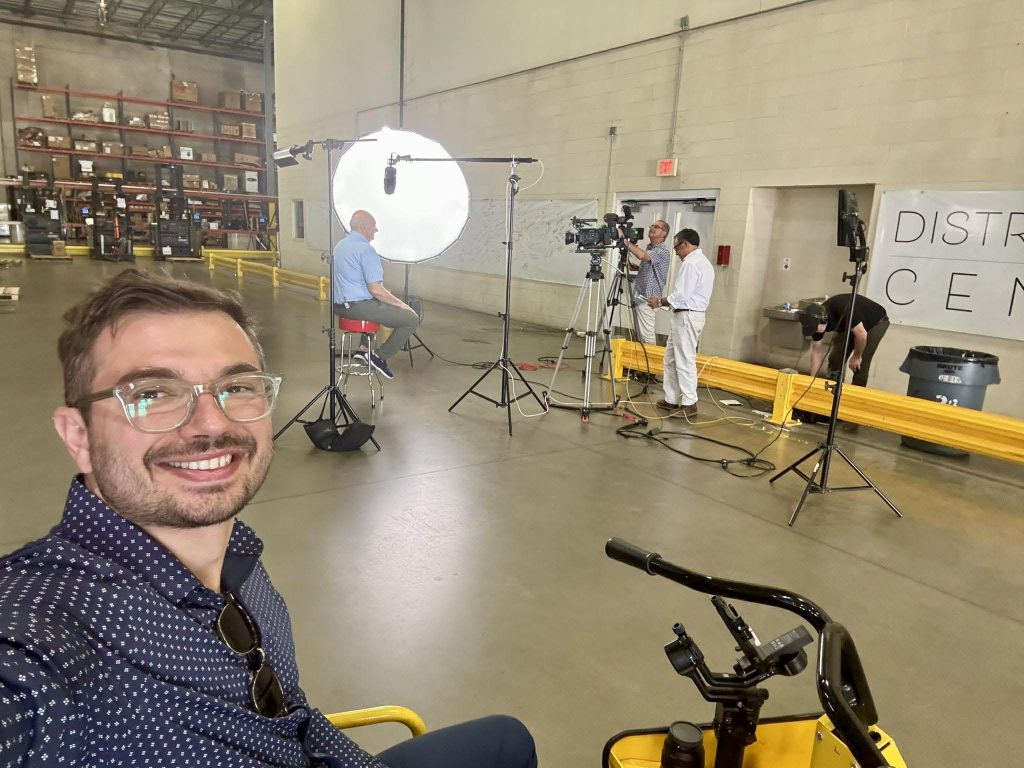
Video SEO in 2026 is not a publishing checklist that happens after a video is finished. It is a production discipline that starts at the brief stage — with keyword-aligned scripting that creates naturally chapter-able narrative structure, professional audio that generates transcripts AI systems can parse accurately, and cinematic production quality that holds viewer attention long enough to generate the retention rates YouTube’s algorithm rewards. Every one of the nine strategies in this guide is either a production decision or a post-production deliverable — which is precisely why the Atlanta video production company you choose determines your video SEO outcomes as much as anything you do after publishing.
Atlanta businesses that invest in production quality and video SEO simultaneously — rather than treating them as separate activities — build the compounding content advantage that makes every new video rank faster than the last. The gap between companies executing all nine strategies and those relying on organic reach alone grows wider every quarter as Google and AI systems increasingly surface structured, optimised, high-retention video content above everything else.
To build a video content and SEO strategy specifically designed for your Atlanta business, reach out to Benjamin Tone directly. Tone Production serves Atlanta’s technology, financial services, healthcare, and corporate sectors with production built to rank — from SEO-aligned scripting and semantic chapter planning through 8K RAW cinema capture, AI-enhanced post-production, VideoObject schema delivery, and platform-specific distribution optimised for every ranking mechanism in this guide.
Stay Connected with the Vision:
- Website: toneproduction.net
- Instagram: @toneproductionagency
- LinkedIn: Tone Production Company
- YouTube: @toneproductionagency
- TikTok: @toneproductionagency
- Twitter/X: @ben_tone
- Facebook: Tone Production Agency
- Review our Work: Yelp
Related posts:
Chicago video production company
mobile al video production company